Every week
Monday, April 27 through
Monday, May 18 at 12:00 PM
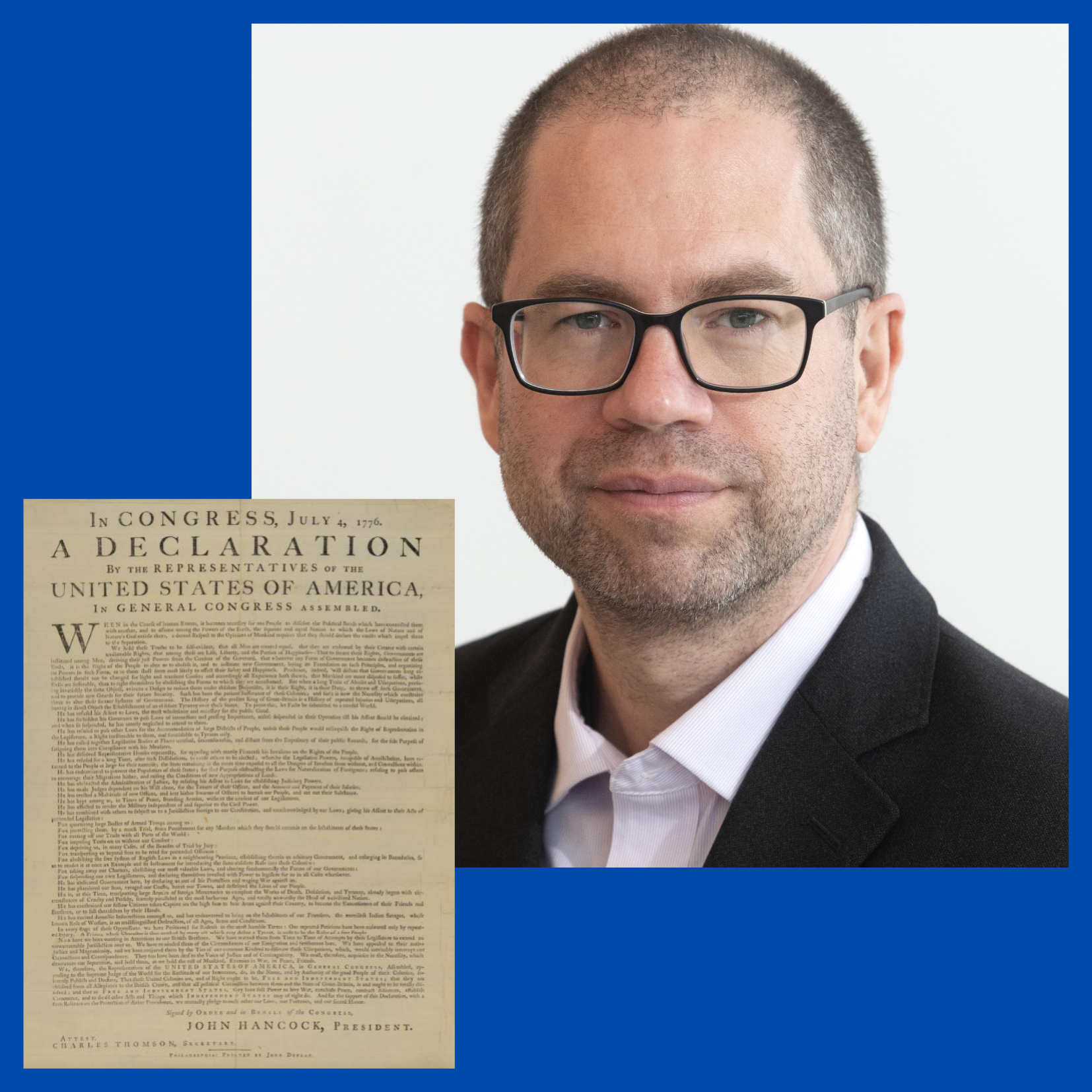
The Declaration of Independence is a peculiar thing. It’s a literary masterpiece that was written jointly by a committee of fifty people. It’s short and punchy—just 1310 words long—but still somehow daunting and difficult to get to grips with. (There’s a reason most of us have never read it in full and can only quote the first third of its second sentence.) And what is it exactly? Is it a birth certificate announcing happy news, or a petition for divorce full of grievance and score-settling, or something else? Is it aimed at the American people, or King George, or someone else? Was it the first ever declaration of independence, or a cheap imitation of a genre already well established? What did people at the time make of it? What did it change? Why does it matter?
In this four-part program, historian Richard Bell, professor of history at the University of Maryland and a specialist in the American Revolutionary era, explores the fascinating origins, misunderstood purpose, and extraordinary global legacy of the Declaration of Independence. Each meeting is 90 minutes inclusive of Q&A.
Part 1: Time to Part
This first talk begins by tracing the remarkable journey of the Declaration of Independence since 1776, including its protection at Fort Knox during WWII, its survival of the 1814 Burning of Washington, and its role in the 1876 Centennial. It then rolls back the clock to examine the crisis of empire in the early 1770s that in the formation of a five-person committee to draft a declaration of independence.
Part 2: These Truths
This second talk explores that committee’s world-shaking draft. Bell begins by deconstructing Jefferson’s celebrated preamble, tracing its roots to the writings of John Locke, George Mason, Jefferson himself, and others, showing how he distilled complex Enlightenment ideas into simpler, more forceful sentences loaded with meaning. Bell then examines the declaration’s central section—a list of more than two dozen grievances—arguing they provide the essential motive for independence.
Part 3: Mr. Jefferson and His Critics
This third talk examines the momentous events that unfolded after Congress finally opened debate on the question of independence on July 1, 1776. After dramatic turns—including a key Delaware vote—Congress approved independence on July 2. The next two days saw Jefferson’s draft declaration heavily edited—86 changes and a quarter of the text cut—resulting in a sharper, more persuasive document. Proclaimed on July 8, it spread rapidly, sparking public celebrations and sharp rebuttals.
Part 4: The Fate of the World
This fourth talk argues that the Declaration of Independence was crafted not only to justify breaking from Britain but to attract foreign allies, leading to its immediate translation into French and Franklin’s mission to Paris. Its bold assertion of sovereignty later inspired more than a hundred similar documents worldwide, fueling independence movements against empires, while at home its language became a touchstone for struggles from abolition and women’s suffrage to civil rights.
There are no required books in this course, but some POST-COURSE recommendations might include:
- Danielle Allen, Our Declaration: A Reading of the Declaration of Independence in Defense of Equality (2014 - 978-1631490446)
- David Armitage, The Declaration of Independence: A Global History (2008 - 978-0674030329)
- William Hogeland, Declaration: The Nine Tumultuous Weeks When America Became Independent, May 1-July 4, 1776 (2010 - 978-1416584094)
- Pauline Maier, American Scripture: Making the Declaration of Independence (1997 - 978-0679779087)
Richard Bell, Professor in the Department of History at the University of Maryland, has published four books and more than a dozen articles and book chapters. He has had major research fellowships at Yale, Cambridge, and the Library of Congress and is the recipient of the National Endowment of the Humanities Public Scholar Award and the Andrew Carnegie Fellowship. He received a BA from the University of Cambridge and a PhD from Harvard University.
All event sales are final.
Athenaeum member price: $120.00
Young Friend price: $60.00
Student price: $60.00
Non-member price: $160.00